



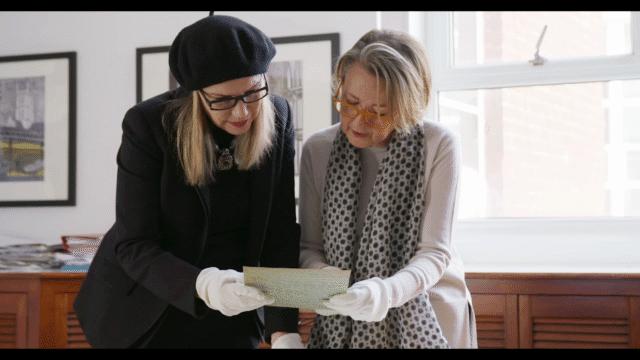
Recently, celebrated concert pianist, author and actor, Mona Golabek, visited World Jewish Relief’s offices to speak about her mother, Lisa Jura – who escaped Austria on the Kindertransport when she was a teenager.
Mona has devoted much of her life to telling her mother’s story, but a remarkable discovery in our archives – which hold documents about many of the 65,000 Jewish refugees World Jewish Relief assisted during the 1930s and 40s – changed her life.
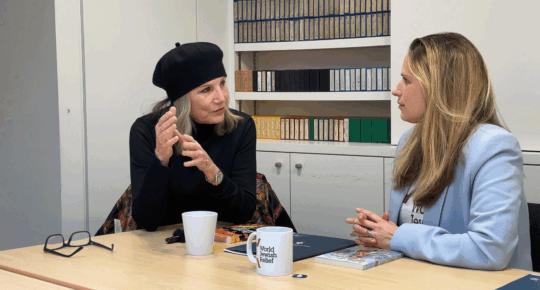

“My mother was born in Vienna in the 1920s… a little child prodigy,” Mona explains. “The most important day of the week was her piano lesson…” But everything changed with the Anschluss. “Her world came crashing down… her teacher told her he could no longer teach her because she was Jewish.”
Amid rising antisemitism and the horrors of Kristallnacht, Lisa’s parents sought desperately to secure safety for their three daughters. Her father obtained a place for 14-year-old Lisa on a train taking unaccompanied Jewish children to Britain. World Jewish Relief, then the Central British Fund (CBF), helped make this rescue possible.
In April 1939, just months before war broke out, Lisa was reunited with her sister Sonja who World Jewish Relief also helped to rescue on the Kindertransport.
Alone in London, Lisa drew strength from her music. “It was the escape valve… she could forget the ugliness that was around her,” Mona says.
Mona grew up hearing her mother’s story and later wrote The Children of Willesden Lane about it. But in 2016, Linda Rosenblatt MBE, Life-Vice President of World Jewish Relief, contacted her: “World Jewish Relief holds historical records about your mother.”
“Meeting Linda was one of the signature days of my life,” Mona recalls as she was given her mother’s papers that brought to life her early years, “how do you describe the magnitude of what you feel? It was like the missing pieces of your legacy.”
“I was stunned… to see in writing the date she came out on that train… the names of my grandparents, whom I never knew. There was a richness of detail I didn’t even know about… the meticulous annotation of her feelings, the description of her actions, the dates, and where they sent her… it just brought her life to life.”
Reflecting on the importance of remembering history, Mona says: “History repeats itself… It’s incumbent on all of us to spread stories of man’s humanity to man, with the hope that maybe that will change the cycle.” Today, she encourages families to explore the archives: “Everyone should reach out to World Jewish Relief… It will change their world to see these documents.”