



Written by James Silverman, Head of Humanitarian Programs, and Roshni Sumitra, Humanitarian and Climate Programs Officer.
Reaching the communities affected by drought in eastern Ethiopia was a journey in every sense of the word.
From London, the journey began with a seven-hour flight to the capital, Addis Ababa, before heading eastward and eventually arriving in Harar town, which served as our main base. From there, the daily journey onward to the communities – another two to three hours on rough, deeply rutted roads – where the program was being implemented.
The final stretch was the most difficult. The roads were long, dusty and extremely bumpy, cutting through remote landscapes where infrastructure is minimal and distances between settlements are vast.
But the moment we reached the area, the scale of the crisis became immediately clear.
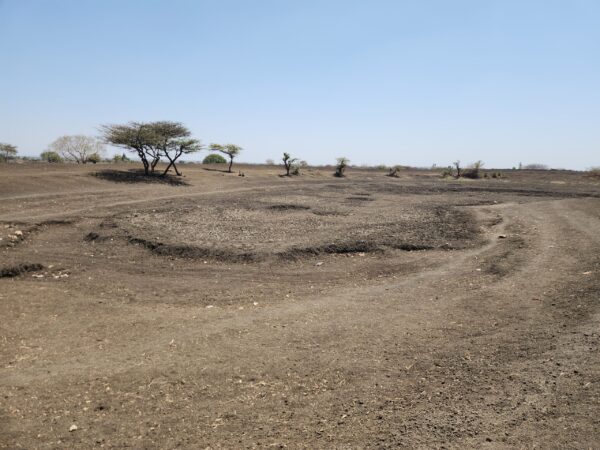
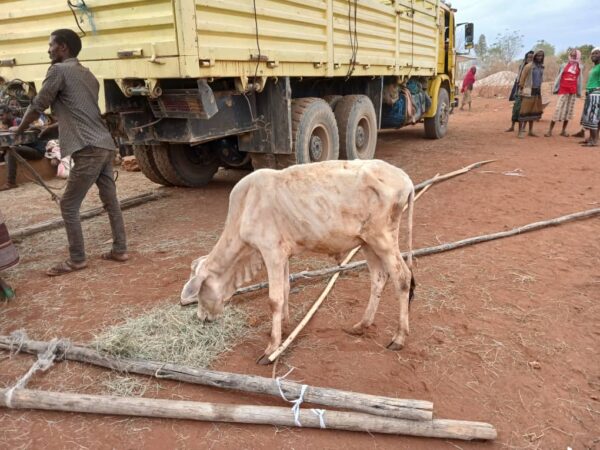
The drought was shocking. For miles and miles, the landscape was covered with failed crops. Fields that should have been green and productive were instead dry and barren. Livestock wandered the roadside in desperate search of food, many reduced to little more than skin and bone. The physical toll on the animals was a stark indicator of the pressure facing the communities that depend on them. Even the camels were skinny with ribs showing; this bastion of drought resistance was too at the edge.
Along the roads, we frequently passed dozens of women walking with their donkeys, moving slowly across the landscape in search of water. Many had traveled for hours already and still had further to go. In some areas, communities were relying on a single muddy pool as their only source of water for more than twenty kilometres in every direction. They would drink from it directly, asking what else are we supposed to drink?
The local communities and authorities told us the rains had not come properly for over three years. With the traditional rainy seasons failing repeatedly, the situation has gradually worsened. For the most rural villages, far from towns and infrastructure, the impact has been devastating.
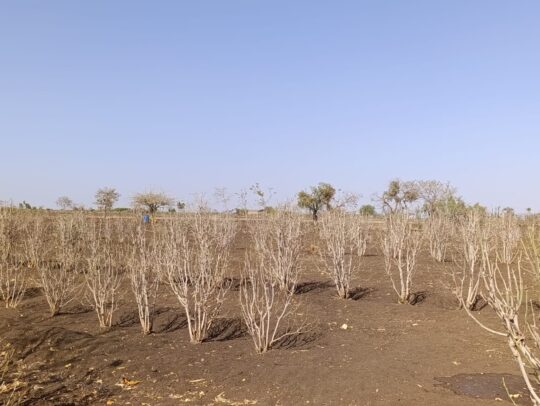
For the families we met, the drought is not a temporary shock – it is an ongoing struggle that shapes every part of daily life and is set to intensify further into a catastrophe if rains do not come.
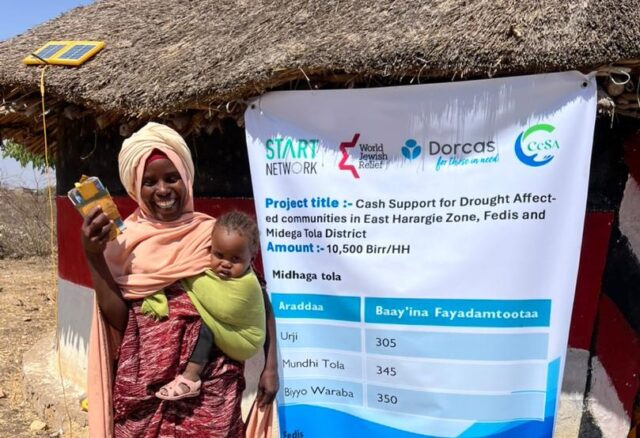
That’s why World Jewish Relief launched an anticipatory response to help people to survive the next few months and build back their livelihoods before things get worse. Funded by the START Network – dedicated to responding to under-the-radar crises and funded in part by the UK Government – our response will reach 28,000 people. This includes:
- Emergency water trucking and borehole rehabilitation
- Cash assistance so families can buy food and essentials
- Animal feed to protect livelihoods
- Protection and disaster risk reduction training
Watch this 90 second video to better understand our response in Ethiopia.
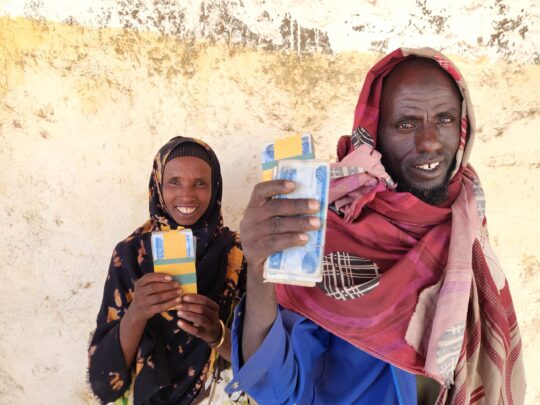

The response is being delivered through a strong partnership between World Jewish Relief, Dorcas, and our local partner Coalition Child Support Association (CcSa). Our teams worked day and night, weekday and weekend, across remote locations and difficult logistics to implement a program that reached thousands of people through multiple interventions. The desperation was perhaps most visible at the water distribution points.
As water trucks arrived, large crowds quickly gathered. The atmosphere was tense and chaotic. People shouted, pushed forward and tried to secure their place in line. The fear of leaving empty-handed was palpable. In places where water is scarce and unpredictable, every delivery is vital.
Among those waiting were many young mothers, some clearly no older than sixteen, carrying one baby while expecting another. In communities where drought has stripped away livelihoods and food security, young families are among the most vulnerable.
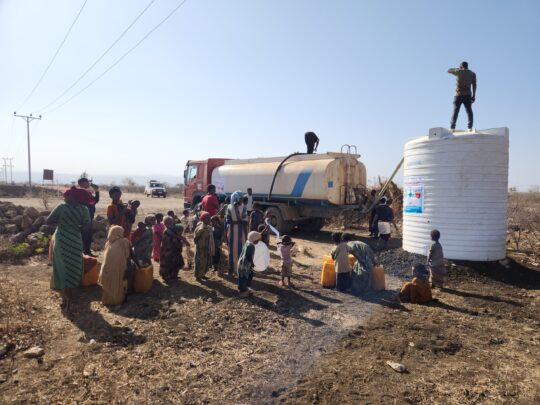
So far, we have reached more than 20,000 people, delivering over 550,000 litres of water to some of the hardest-hit communities. Large water tanks were installed at key collection points, allowing families to access safe water closer to home. By the end of the program, well over 1 million litres of water is planned to be delivered. The gratitude of the community was immense, even if this is just temporary relief.
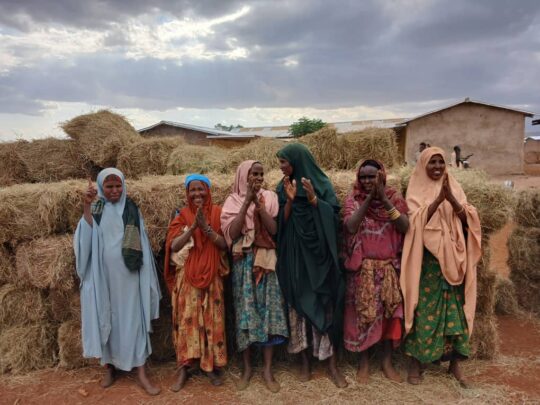
We also provided animal feed to livestock-dependent households, helping protect one of the few remaining assets many families still have. Livestock are a vital source of food and income, providing milk, eggs and meat. However, in the midst of the drought many animals had become severely emaciated and were producing none of these, worsening food insecurity for already vulnerable communities.
Without support, many households would be forced to sell their livestock at the worst possible moment – when the animals are weakest and when many others are also selling. This combination drives prices down sharply, often pushing families into debt. By providing animal feed, we were able to help restore livestock health, protect household assets, and support families to maintain their food security while avoiding harmful coping strategies.
What was striking was how few humanitarian actors were present in the area. For much of the response period, only a handful of organisations were working in these communities. A few others arrived later, but the scale of need remains far greater than the resources currently available.
The next rainy season, expected in March, is already predicted to fail again. If those rains do not arrive, the pressure on these communities will only intensify. And yet, despite the hardship, there is also resilience. Communities continue to adapt, support each other, and hold on to hope that the rains will return.
For our team, the visit was a powerful reminder of both the scale of the crisis and the importance of locally led humanitarian response. In some of the most remote and overlooked communities, dedicated teams are working every day to deliver life-saving support under extremely challenging conditions.
The road to reach these communities may be long and difficult – but the work being done there could not be more important.